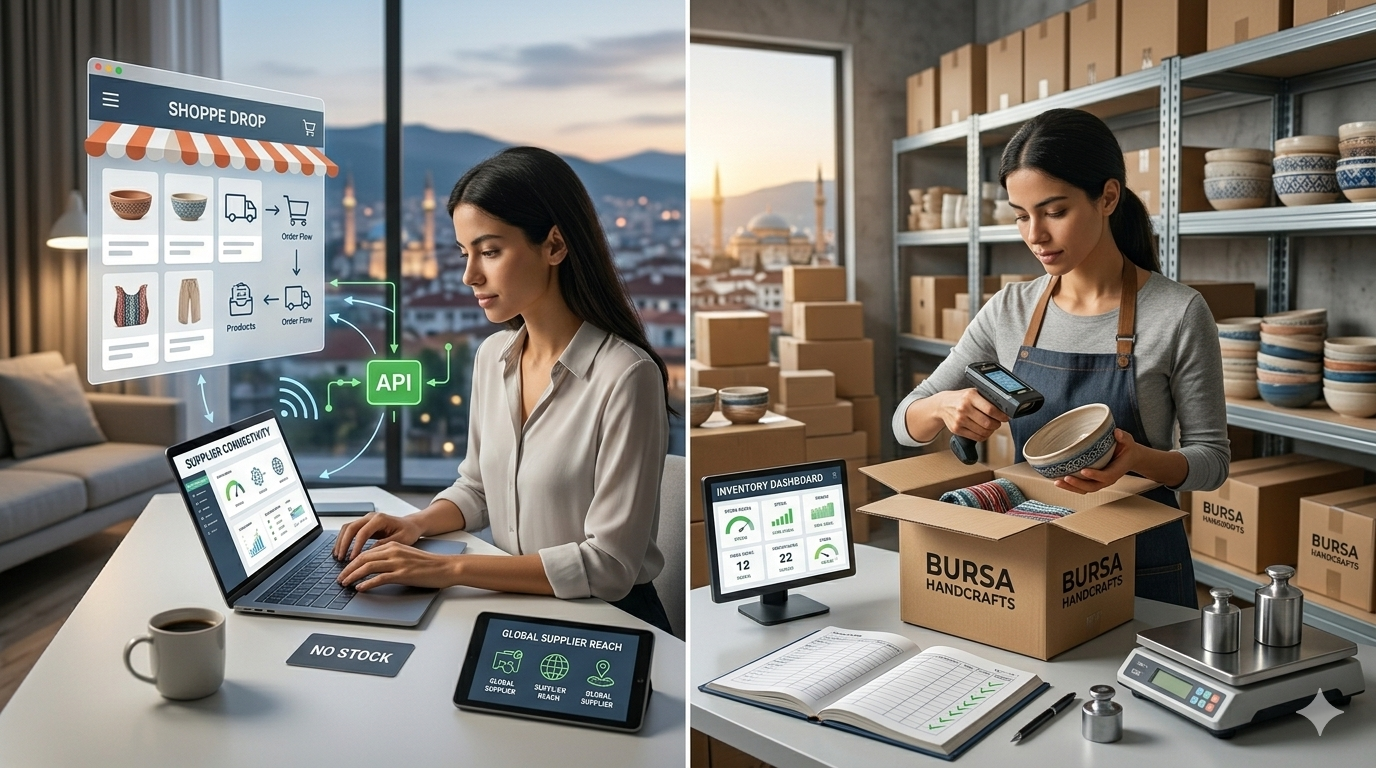
The dropshipping vs own stock debate is the fundamental question every entrepreneur faces when entering e-commerce. Choosing the right business model directly affects your start-up costs, your day-to-day operations and your long-term profitability. In this guide we examine both models in every dimension to help you determine which one suits you best.
What Is Dropshipping and How Does It Work?
Dropshipping is an e-commerce model in which you sell products without stocking them. When a customer places an order, you forward it to your supplier, and the supplier ships the product directly to the customer. Your profit is simply the difference between the sale price and the supplier's price. This model frees you from traditional retail burdens such as warehousing, inventory and logistics.
- Low Start-Up Cost: Because you do not have to purchase stock, your initial capital consists only of site set-up and marketing expenses; you can usually start with 500-2000 USD.
- Wide Product Range: Without being limited to a single supplier or niche, you can easily list thousands of different products.
- Flexibility: You can run your business from anywhere in the world without being tied to a physical warehouse or office.
- Low Risk: With no cost of unsold stock, the trial-and-error process for products is far cheaper.
The Disadvantages of Dropshipping
Like every model, dropshipping has serious disadvantages. Ignoring these points can lead to major disappointment further down the line.
Low Profit Margins
In dropshipping, supplier prices are generally above wholesale prices. The average profit margin ranges between 10 and 30 percent, and intense competition can narrow this margin even further. Competing with the prices of giants such as Amazon and AliExpress is extremely difficult. After advertising costs are deducted, the net profit is often disappointing.
Supplier Dependence and Quality Control
You sell products without ever seeing them, which opens the door to serious quality problems. When a supplier removes a product from stock or raises its price, you are affected immediately. You have no control over shipping times; delays translate directly into customer dissatisfaction. Returns and customer service processes also become complicated.
The Advantages of Holding Your Own Stock
Holding your own stock is the traditional e-commerce model. You buy products wholesale or have them manufactured, store them in your warehouse and fulfil orders yourself. Although this model requires a higher initial investment, it offers a far stronger business infrastructure in the long run.
High Profit Margins
When you buy products wholesale or directly from the manufacturer, profit margins of 40-70 percent are achievable compared with dropshipping. For private label products in particular, this figure can even exceed 80 percent. Higher margins deliver sustainable growth once advertising spend has been covered.
Brand Control and Customer Experience
When you ship products from your own warehouse, packaging, inserts and the unboxing experience are entirely in your hands. Delivering a consistent customer experience while building a brand identity becomes much easier. You manage shipping times and logistics quality yourself; customer satisfaction is directly under your control.
Start-Up Cost Comparison
The difference in start-up costs between the two models is a decisive factor. To make the right decision, you need to see the figures clearly.
- Dropshipping start-up: 300-500 USD for site set-up (Shopify, WooCommerce), 500-1500 USD for the initial advertising budget; you can start with a total of 1000-2000 USD.
- Own-stock start-up: a minimum of 2000-10,000 USD for stock purchases, additional costs for a warehouse or shipping agreement, and a total of 5000-20,000 USD including site set-up.
- Hybrid model start-up: a few core products are stocked and the rest is supplied through dropshipping; a balanced start can be made with 2000-5000 USD.
Supplier Relationships and Long-Term Strategy
Whichever model you choose, supplier relationships form the backbone of your business. In dropshipping, it is critical to put SLA (Service Level Agreement) contracts in place when working with Alibaba, AliExpress or domestic suppliers. In the own-stock model, cost advantages can be secured by negotiating long-term contracts and volume discounts. In both cases, supplier diversification eliminates the risk of depending on a single point of failure.
Frequently Asked Questions
How much can you earn per month with dropshipping?
Dropshipping income varies widely depending on niche selection, advertising budget and supplier quality. In the early stage, a net profit of 500-2000 USD per month can be a realistic target. Although this figure may rise as you scale, high advertising costs squeeze the margin.
When does holding my own stock make sense?
When your sales exceed 100-200 orders per month, when you have established a stable product catalogue, and when you want to build a brand identity, switching to your own stock offers serious advantages. Holding stock also protects customer satisfaction when you receive constant complaints about your dropshipping supplier's performance.
How is a hybrid model set up?
In the hybrid model you stock your best-selling, high-margin products yourself and fulfil long-tail or trial-stage products through dropshipping. This approach both balances cash flow and offers a wide product range. On Shopify and WooCommerce, it is possible to manage both models simultaneously with dropshipping plugins.
Which model is more advantageous for SEO?
The SEO strategy is similar in both models; however, creating original product descriptions and brand content is easier in the own-stock model. In dropshipping, copying supplier descriptions leads to duplicate content problems. Producing original content is essential for organic rankings in both models.
Conclusion
The dropshipping vs own stock decision should be shaped by your budget, your risk tolerance and your long-term goals. If your capital is limited, the smartest strategy is to start with dropshipping to test the market, then move to a hybrid model by stocking proven products. Contact Toserof Tech. to optimise your e-commerce strategy.