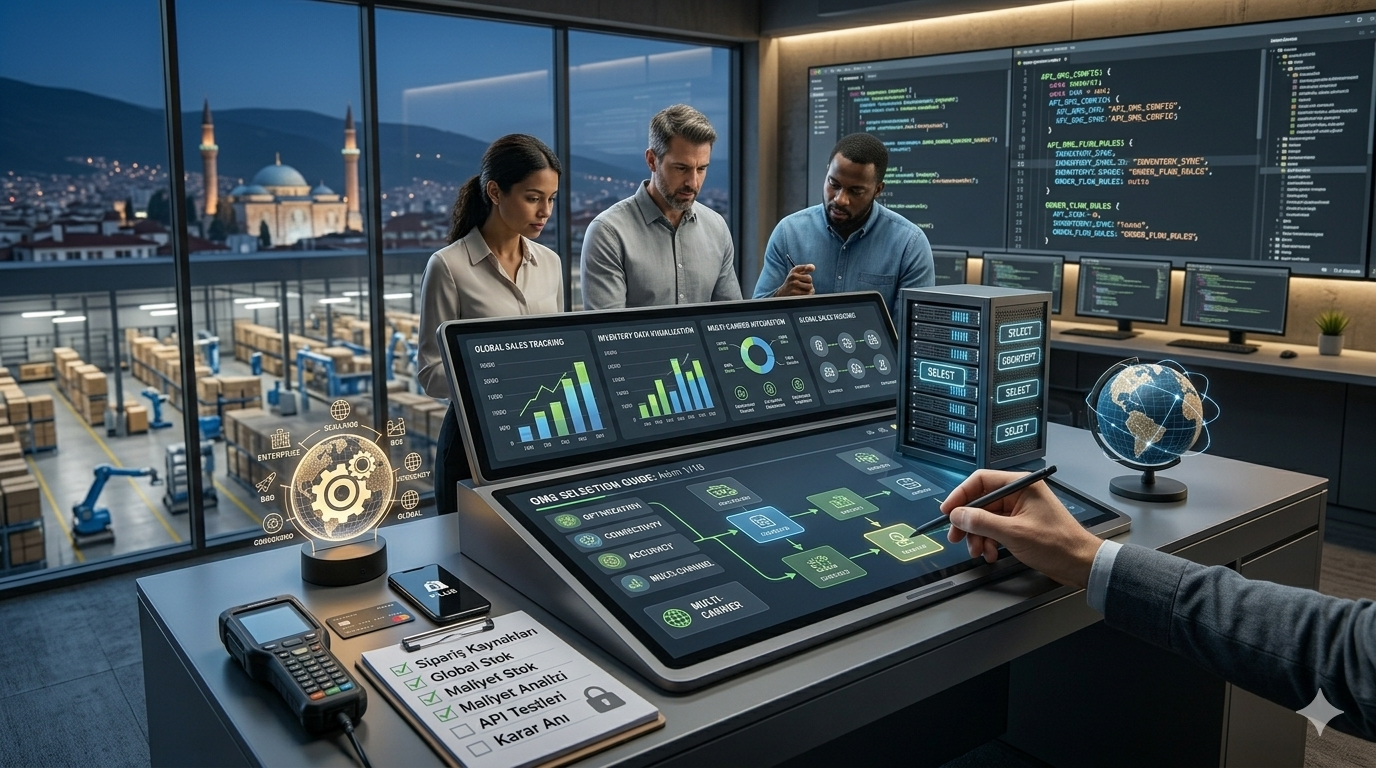
An order management system (OMS) is the software infrastructure at the centre of e-commerce operations, coordinating the entire process from the moment an order is received to its delivery. For businesses selling across multiple channels or working with different warehouses or suppliers, an OMS is no longer a luxury but an operational necessity. In this guide we cover every dimension of the OMS selection process.
What Is an Order Management System (OMS) and Why Is It Critical?
An OMS is the software layer that collects orders from different channels such as the website, marketplaces, physical stores and telephone into a single central system, reserves stock, initiates the fulfilment process and keeps the customer informed. When cross-channel order management is handled manually, the error rate rises dramatically: customers are sold products that are out of stock, orders are processed late and returns become chaotic. A good OMS, by contrast, improves stock accuracy, shortens order-processing time and strengthens customer satisfaction.
- Centralised Order View: Orders from every channel, including Amazon, Trendyol, Hepsiburada and your website, are monitored and managed on a single dashboard.
- Real-Time Stock Reservation: The relevant product stock is reserved the moment an order is received, preventing the same item from being sold twice across multiple channels.
- Automatic Fulfilment Routing: Orders are routed automatically according to the nearest warehouse, the lowest-cost supplier or custom fulfilment rules.
- Returns Management: Return requests, product inspection, restocking and customer refunds are handled through traceable workflows in the OMS.
A Comparison of Popular OMS Solutions
There are dozens of OMS solutions on the market, but the platforms that stand out among e-commerce businesses in 2026 are OrderMS, Brightpearl and Linnworks. The most suitable choice varies according to the size of your business, the number of channels and your integration requirements.
Brightpearl: A Retail-Focused OMS
Brightpearl is a comprehensive retail operations platform designed specifically for multi-channel retailers. It offers order management, inventory management, CRM, finance and reporting modules under one roof. Native integrations are available with Shopify, Magento, Amazon and eBay. Its automation-focused structure reduces the manual steps per order. It is a strong choice for mid-sized and large retailers.
Linnworks: A Powerhouse for Multi-Channel Selling
Linnworks is a powerful OMS solution, especially for businesses whose sales are marketplace-heavy. It integrates with Amazon, eBay, Etsy, Shopify and more than 100 other channels. It combines features such as stock synchronisation, order-routing rules, carrier integrations and purchase-order management. Its API access is flexible, and custom workflows can be built easily.
A Multi-Channel Order Management Strategy
For a business selling across multiple channels, the value of an OMS multiplies. Different channels can have different customer expectations, different shipping times and different returns policies. An OMS lets you manage this complexity from a single centre.
Fulfilment Prioritisation Rules
If an order can be fulfilled from more than one warehouse, the OMS needs to choose the right one. This choice can be based on criteria such as distance to the customer, warehouse occupancy, specific product location or cost optimisation. Advanced OMS platforms let you define these rules easily through a visual interface.
Measuring OMS Performance with KPI Metrics
Just as important as implementing the OMS is measuring whether the system is running healthily. The key metrics to track are: perfect order rate, order-processing time, return rate, stock-accuracy rate and cost per order. Monitoring this data in regular reports lets you quickly identify areas for operational improvement.
OMS Selection Criteria
To choose the right OMS you need to go beyond technical features and clarify your business requirements. How many channels do you sell on, what is your monthly order volume, which ERP or accounting software do you use, and how much growth are you targeting over the next 3 years? The answers to these questions directly determine the OMS choice.
- Breadth of Integration: Compatibility with your existing e-commerce platform, carriers and accounting software should be the primary criterion.
- Scalability: When order volume doubles, the system should keep running without slowing down and additional licensing costs should be reasonable.
- Quality of Support: Having a technical support team you can reach at the moment an error affects your operation is critically important.
- Customisation Options: Being able to reflect your business's unique order rules and workflows in the system provides a competitive advantage.
Frequently Asked Questions
What is the difference between an OMS and a WMS?
An OMS (Order Management System) manages the process from order receipt to delivery, whereas a WMS (Warehouse Management System) optimises the physical operations inside the warehouse, namely product placement, picking and packing. In large operations the two systems work together.
Do small businesses need an OMS?
For small businesses selling through a single channel and processing fewer than 20-30 orders a day, the e-commerce platform's built-in order management may be sufficient. However, once you begin selling on multiple channels or order volume grows, investing in an OMS becomes essential.
How much does an OMS implementation cost?
OMS costs vary widely depending on the solution. SaaS solutions such as Linnworks start from a few hundred dollars a month, while enterprise OMS projects can reach hundreds of thousands of dollars. Your order volume and integration requirements determine the total cost of ownership.
How does an OMS reduce order errors?
An OMS minimises human error through stock reservation and automatic fulfilment routing. The error rate can be lowered further by adding barcode verification, packing checklists and double-check rules.
Conclusion
An order management system (OMS) is an indispensable infrastructure component of multi-channel e-commerce operations. With the right OMS choice and the right configuration, you can reduce order errors, increase customer satisfaction and lower your operational costs. Get in touch with Toserof Tech. for e-commerce infrastructure solutions.