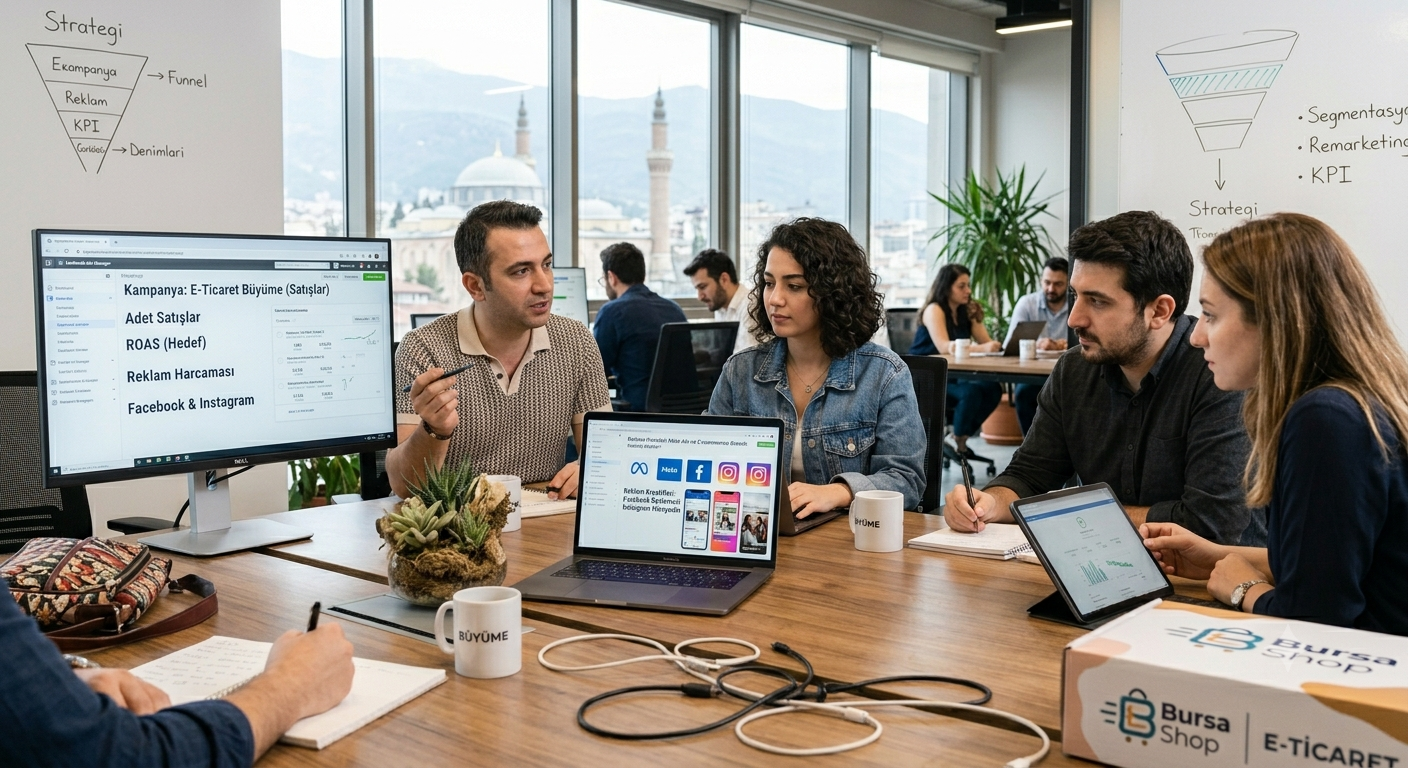
The Meta Ads Facebook Instagram e-commerce ecosystem is a powerful advertising platform that offers the opportunity to reach billions of users worldwide. Configuring Facebook and Instagram ads correctly requires an integrated strategy that covers the entire customer journey, from brand awareness through to purchase. In this guide we cover every critical e-commerce topic, from setting up Meta Business Suite to Advantage+ campaigns, and from post-iOS 14 attribution issues to managing ad fatigue.
Meta Business Suite and Account Configuration
Successful Meta Ads campaigns are built on the right infrastructure. Meta Business Suite lets you manage your ad accounts, pages, Pixel data and team members from a central location. When creating your business account, open Business Manager with your company email, connect your Facebook Page and Instagram account, create an ad account and define your payment method. If you need more than one ad account (for different brands or markets) you can manage them all under the same Business Manager. Maintain security by giving team members role-based access; each person should have only the permissions they need.
- Meta Pixel Setup: Activate the Pixel on every page of your website; for e-commerce, fire the ViewContent, AddToCart, InitiateCheckout, Purchase and Search standard events. Installing via Google Tag Manager provides technical flexibility and easy management.
- Conversions API (CAPI): Browser-based tracking was severely restricted after iOS 14; the Conversions API complements the Pixel by sending data server-side and closes attribution gaps. Native integration options are available for platforms such as Shopify and WooCommerce.
- Catalogue Integration: Create your product catalogue through Facebook Commerce Manager and use a data feed URL, the Meta Pixel or a platform integration as the data source; the catalogue is mandatory for Dynamic Ads and Advantage+ campaigns.
Funnel-Based Campaign Structure: TOF, MOF, BOF
An effective Meta Ads strategy requires campaigns that address every stage of the customer journey. The Top of Funnel (TOF), Middle of Funnel (MOF) and Bottom of Funnel (BOF) structure lets you use your budget efficiently and deliver the right message to the right person.
Top of Funnel: Awareness and Discovery
In TOF campaigns your aim is to reach broad audiences who do not yet know your brand. Use broad interest-based targeting, lookalike audiences and Advantage+ audience. Video ads, carousel and collection formats are ideal for TOF; your message should focus on the value proposition and problem-solving rather than on the product. Allocate 30-40 percent of your total Meta Ads budget to TOF. Monitor frequency; more than 3 impressions to the same person within 7 days can cause fatigue.
Middle and Bottom of Funnel: Conversion
In MOF, retarget users who visited your website but did not purchase; use content ads, testimonials and social proof elements. In BOF, focus on users who added to cart but did not buy, or who viewed specific product pages; Dynamic Product Ads produce the highest ROAS at this stage. In BOF campaigns, strong CTAs, discount offers and urgency elements (limited stock, last day) accelerate conversion.
Advantage+ Shopping Campaigns
Meta's AI-driven Advantage+ Shopping Campaigns (ASC) automatically optimise across the whole of Meta's inventory, in a similar way to Google Performance Max. ASC manages existing customer and prospective customer segments within the same campaign while the algorithm allocates budget automatically. During campaign setup, upload your existing customer list and set the existing customer budget cap (between 0 and 30 percent); this cap controls the share of budget allocated to retargeting existing customers. Creative diversity is critical to the success of ASC; upload at least 10-15 different image/video assets and let the algorithm learn the best-performing combinations.
Building Target Audiences: Lookalike and Custom Audiences
Meta's targeting power comes from using lookalike and custom audiences derived from high-quality source audiences. Upload a customer list based on purchase history and create a 1-3 percent lookalike audience; this audience usually produces the highest conversion rate. For website visitor audiences, create separate audiences for the last 30, 60, 90 and 180 days. Use video view audiences (25, 50 and 75 percent viewing thresholds) for TOF retargeting. Engagement audiences (people who interacted with your page and profile) form a strong source for MOF.
Post-iOS 14 Attribution and Creative Management
Apple's App Tracking Transparency (ATT) framework fundamentally changed Meta's attribution model. Many iOS users now decline tracking permission, which results in missing conversion data in reports. Set your attribution window to 7-day click and 1-day view; this is a balanced approach that minimises data loss. Keep the Conversions API active to enrich server-side data and verify your Meta Aggregated Event Measurement settings. To manage ad fatigue, monitor the Frequency report regularly; rotate high-frequency ads or refresh the creative. Testing new creative variations every 2-3 weeks is the most effective way to prevent performance decline.
Frequently Asked Questions
What is the difference between the Meta Pixel and the Conversions API?
The Meta Pixel works browser-side and tracks the actions a user takes in their browser. The Conversions API works server-side; it sends data directly to Meta without being affected by the user's browser settings. After the iOS 14 restrictions, using both together is the correct approach; the Pixel + CAPI combination improves data integrity and attribution quality.
When should Advantage+ Shopping Campaigns be used?
ASC works efficiently in accounts with at least 50-100 purchase conversions per month. For new accounts or campaigns with low conversion volume, it is recommended to first accumulate data with a manual campaign structure. ASC is a particularly powerful tool for scaling during high-volume periods such as Q4.
Should Facebook and Instagram have separate campaigns or a single campaign?
Initially you can run on both platforms using automatic placements (Advantage+ Placements); the algorithm distributes the budget according to the best performance. However, if you want to test creative specific to certain formats (Instagram Reels, Facebook Feed), a separate platform-based ad set structure offers a more controlled testing environment.
How do you recognise and resolve ad fatigue?
Ad fatigue sets in when frequency rises above 3 and CTR starts to decline. To resolve it, refresh the creative, try a different format (carousel instead of video or vice versa), broaden the target audience or change the message. Producing new creative at regular intervals and running A/B tests preserves long-term performance.
Conclusion
A Meta Ads Facebook Instagram e-commerce strategy turns into a strong and scalable sales channel when it is run with a solid technical infrastructure, a funnel-based campaign structure, high-quality audiences and continuously refreshed creative. Adapting to the platform's changing attribution environment and making effective use of AI-driven tools will put you ahead of the competition. Get in touch with Toserof Tech. about your digital advertising strategy.