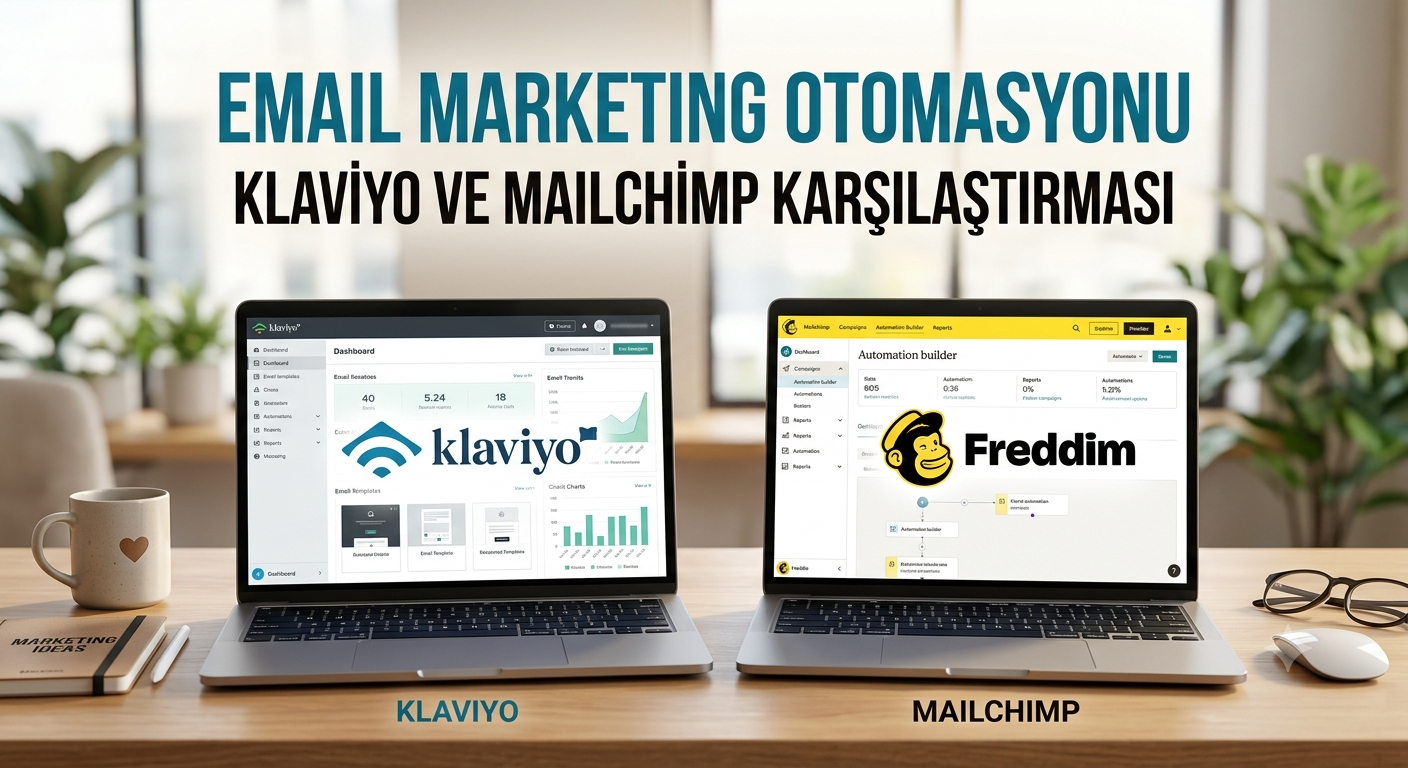
The email marketing automation Klaviyo vs Mailchimp debate is one of the most frequently asked questions in the e-commerce world. Choosing the right platform plays a decisive role in revenue growth, customer loyalty and marketing efficiency. In this guide we compare the Klaviyo, Mailchimp and Omnisend platforms in depth and help you find the most suitable solution for your business.
Klaviyo, Mailchimp and Omnisend: The Key Differences
All three platforms offer email marketing automation; however, their priorities and target audiences differ markedly. Klaviyo stands out with its in-depth, e-commerce-focused data analytics, while Mailchimp offers small and medium-sized businesses a broad toolset. Omnisend, meanwhile, draws attention with its multi-channel automation and SMS integration.
- Klaviyo: Native integration with Shopify, WooCommerce and BigCommerce; revenue attribution, product-based segmentation and behavioural triggers. The first choice for high-revenue e-commerce brands.
- Mailchimp: Easy-to-use interface, extensive template library, free plan (up to 500 contacts). Suitable for blogs, content marketing and small-scale e-commerce.
- Omnisend: Email + SMS + web push notification combination, e-commerce automation and competitive pricing. A cost-effective option for mid-sized stores.
Pricing Comparison
The pricing model is a critical factor in platform selection. All three platforms charge according to list size; however, their calculation methods differ.
Klaviyo Pricing
Klaviyo prices according to the number of active profiles. It is free for up to 1,000 contacts (500 emails/month) and starts from 45 USD per month for 1,001-1,500 profiles. For up to 10,000 profiles it reaches roughly 150 USD/month. For high-revenue stores the ROI usually more than covers the price, since the revenue attribution reports clearly show how many dollars each automation has earned. The SMS package is charged separately and is available in more than 20 countries, including Turkey.
Mailchimp Pricing
Mailchimp offers three paid plans: Essentials, Standard and Premium. A free plan is available for up to 500 contacts; however, automation features are limited. For 500 contacts the Standard plan starts from roughly 17 USD per month. Advanced e-commerce automations such as abandoned cart and product recommendations are only available on the Standard and Premium plans.
Omnisend Pricing
Omnisend is free for up to 500 contacts (500 emails/month), while the Pro plan starts from 16 USD per month for 500 contacts. SMS messages are purchased with separate credits. All e-commerce features are unlocked on every paid plan, which makes Omnisend the most transparent option in terms of cost.
Native E-Commerce Integrations
Deep integration with your e-commerce store is essential for advanced segmentation and personalisation. When choosing a platform, always check compatibility with your existing technology stack.
Shopify Integration
Klaviyo is Shopify's official email marketing partner and offers the deepest integration. One-click setup, real-time order data synchronisation, product catalogue access and automation triggers via Shopify Flow are all available. Mailchimp was removed from the Shopify app store in 2019; however, it continues to work through third-party integrations. Omnisend offers an experience close to Klaviyo's in its Shopify integration and synchronises all order data instantly.
WooCommerce and BigCommerce Integration
For WooCommerce, all three platforms offer an official plugin or API integration. Klaviyo's WooCommerce plugin pulls in cart data and the product catalogue in full. Omnisend also has a strong native plugin for WooCommerce. Mailchimp's WooCommerce integration works at a basic level; however, advanced behavioural triggers are limited.
Automation Flows
Automation flows form the backbone of a successful email marketing strategy. Below is a platform comparison for the three most critical flow types.
Welcome Series
In Klaviyo, the welcome series lets you build multi-step flows that branch according to subscriber source and segment. Conditional logic (conditional split), A/B testing and time delays are fully under your control. With the Mailchimp Standard plan a multi-step welcome series can be set up; however, conditional branching is limited. Omnisend offers quick setup with its drag-and-drop editor, and adding an SMS step is possible with a single click.
Abandoned Cart
Abandoned cart automation delivers an average of 15-25 percent in additional revenue for e-commerce stores. Klaviyo produces personalised messages by combining the products in the abandoned cart, the customer's past purchase data and their CLV segment. Omnisend builds a multi-channel abandoned cart flow with an email + SMS + web push combination. Mailchimp also offers abandoned cart automation; however, the depth of personalisation is limited compared with the others.
Segmentation, A/B Testing and Deliverability
Klaviyo offers RFM analysis, predictive segmentation and dynamic segments based on behavioural events. Mailchimp offers tag-based segmentation and basic behavioural filters; it can fall short for in-depth segmentation based on e-commerce data. In terms of A/B testing, Klaviyo supports subject line, send time and full email content tests. For deliverability, Klaviyo offers a dedicated IP option while Mailchimp works with a shared IP pool. Omnisend reports consistent inbox rates with its infrastructure optimised for e-commerce sending.
Migration Steps
When switching from your current platform, data loss and subscriber list integrity are the most critical concerns. By following the steps below you can carry out a safe migration.
- List Export: Export all your subscribers from the current platform in CSV format; include segments and tags.
- Suppression List: Be sure to migrate the unsubscribe and bounce lists; otherwise deliverability will be seriously damaged.
- Integration Setup: Connect the new platform to your e-commerce store and synchronise historical order data.
- IP Warm-up: If you are using a dedicated IP for a high-volume list, follow the warm-up plan; send to small groups during the first week.
- Parallel Running: Keep both platforms active for at least two weeks; compare metrics to ensure an uninterrupted transition.
- DNS Records: Update the SPF, DKIM and DMARC records for the new platform.
Frequently Asked Questions
Should I choose Klaviyo or Mailchimp?
If you run an e-commerce store and revenue attribution and deep segmentation are your priorities, Klaviyo is far ahead. For a blog or a small-scale list, Mailchimp's free plan is a good starting point.
How does Omnisend differ from Klaviyo?
Omnisend is a more affordable option than Klaviyo for combining SMS and web push notifications with email in the same flow. Klaviyo, on the other hand, goes deeper in predictive segmentation and revenue reporting.
How can email deliverability be improved?
Configure the SPF, DKIM and DMARC records correctly; clean your list regularly and move low-engagement subscribers to the suppression list. If you are using a new IP, be sure to follow the warm-up plan.
How long does a migration take?
Depending on list size, a typical migration takes 2-6 weeks. At least one month of parallel running is recommended for IP warm-up and performance optimisation.
Conclusion
The right choice among the email marketing automation trio of Klaviyo, Mailchimp and Omnisend depends on the size of your store, your budget and your integration needs. Klaviyo stands out for high-volume e-commerce, Mailchimp for small lists and Omnisend for multi-channel automation. Get in touch with Toserof Tech. about digital marketing solutions.