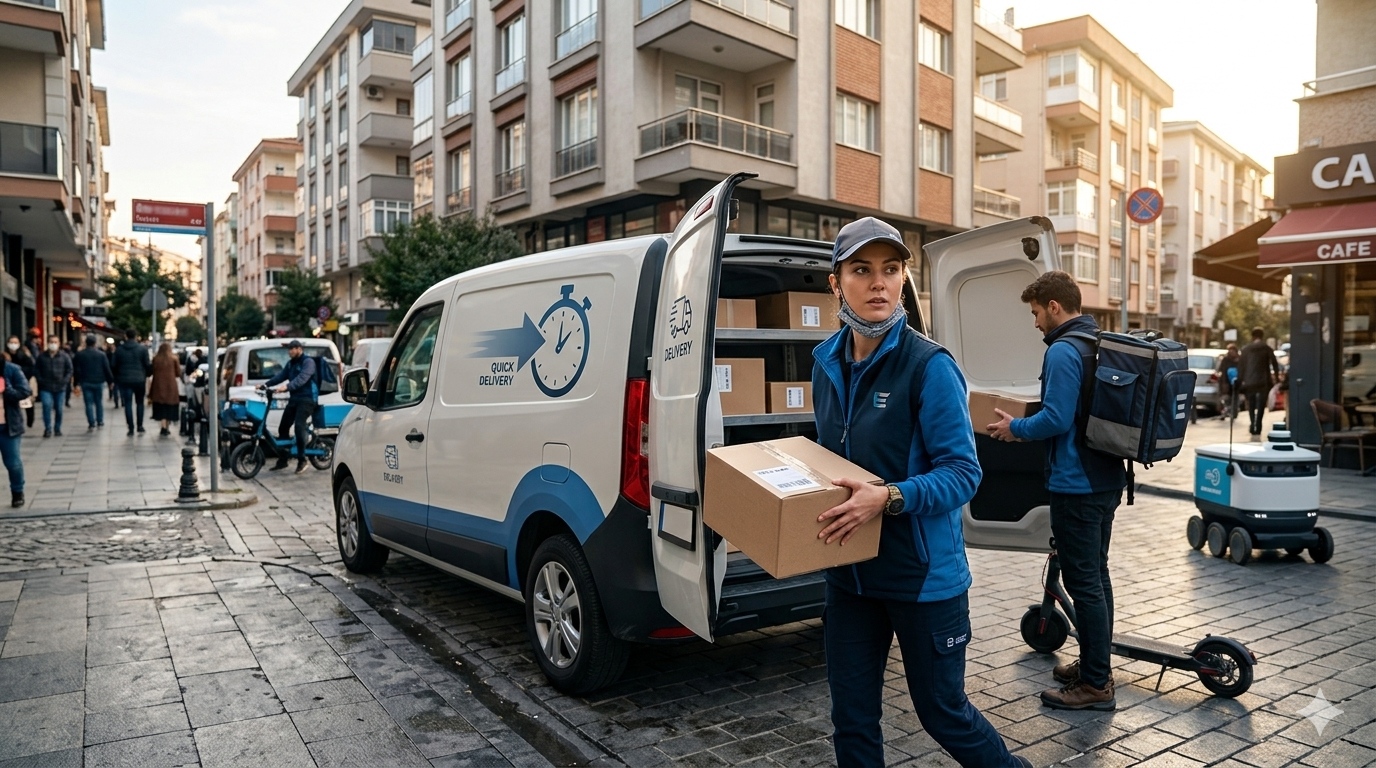
Same-day delivery in e-commerce has become one of the most powerful ways to create a competitive advantage. As customers' expectations of same-day delivery keep rising, offering this service in an operationally sustainable and profitable way requires serious planning. From warehouse location to last-mile logistics, and from order cut-off management to the technology stack, every detail determines success.
What Is Same-Day Delivery and Why Does It Matter?
Same-day delivery means the product is delivered on the same day the customer places the order. Compared with the traditional e-commerce model, this service increases customer satisfaction, lowers the cart-abandonment rate and strengthens loyalty. Research shows that the average order value rises by 20-30 percent when a same-day delivery option is available. Since Amazon Prime popularised same-day delivery, the vast majority of consumers now prefer this option.
- Customer Satisfaction: Fast delivery increases the likelihood of positive reviews and repeat purchases.
- Competitive Advantage: Businesses offering same-day delivery become indispensable to buyers who need something today.
- Higher Conversion: Seeing a same-day delivery option at checkout nudges undecided shoppers towards purchasing.
- Premium Pricing: Customers are willing to pay extra for speed, which generates shipping revenue.
Operational Requirements: The Foundations of Same-Day Delivery
Offering same-day delivery requires far more preparation than a standard e-commerce operation. For the service to run sustainably, warehouse automation, optimised pick-and-pack processes and reliable last-mile partners are vital. Announcing the service before you are operationally ready can lead to failed deliveries and lost customers.
Warehouse Location Strategy
The physical foundation of same-day delivery is the proximity of the warehouse to the areas being served. In large cities such as Istanbul, the ideal is to position a warehouse or dark store (a small warehouse used solely for preparing online orders) no more than 30-45 minutes from the districts where your customers are concentrated. If you have customers in several regions, you can set up small warehouses close to each of them using the micro-fulfilment centre (MFC) approach. For e-commerce companies in Turkey, establishing separate warehouse points on the European and Anatolian sides is an effective way to extend same-day coverage across Istanbul.
Managing the Order Cut-Off Time
Perhaps the most critical operational parameter in same-day delivery is the order cut-off time. The cut-off time specifies the latest time an order must be placed to be delivered the same day. It is determined by your warehouse's processing capacity, the delivery route and your courier partner's operational start time. In a typical arrangement, orders placed before noon are delivered the same afternoon, and orders placed by 14:00 are delivered in the evening. Stating the cut-off time clearly on your website and checkout page allows you to manage customer expectations properly.
Last-Mile Delivery Solutions
Last-mile delivery, the stage from the warehouse to the customer's door, is the critical phase that accounts for the largest share of total logistics cost. For same-day delivery, last-mile optimisation is the key to success. There are three basic approaches: building your own courier fleet, working with third-party courier platforms or applying a hybrid model.
- Your Own Courier Fleet: Provides full control, but requires high fixed costs (vehicles, insurance, staff). It becomes cost-effective at high order volumes.
- On-Demand Courier Platforms: Platforms such as Getir İş, Motokuryem and Migros Hızlı Teslimat offer flexible capacity, but the cost per order is high.
- Hybrid Model: Using your own couriers in dense areas and platforms for remote locations provides the optimal cost balance.
- Route Optimisation: Route-optimisation software (OptimoRoute, Route4Me) increases the number of orders delivered per courier and lowers the unit cost.
Companies Offering Same-Day Delivery in Turkey
A number of companies in Turkey offer a ready-made same-day delivery infrastructure. Getir İş provides fast-delivery solutions aimed at small and medium-sized e-commerce businesses. Yurtiçi Kargo's "Same-Day Delivery" service is active in selected cities. MNG Kargo's "Fast Delivery" package offers a similar service. In addition, marketplace platforms such as Shopier, Trendyol and Hepsiburada provide sellers with same-day delivery infrastructure through their own fulfilment networks. For businesses that are not ready to build their own integrated logistics network, these marketplace fulfilment services are a cost-effective starting point.
Cost Analysis and Pricing Strategy
The unit cost of same-day delivery is typically 2-4 times higher than standard shipping. This cost covers courier fees, route-optimisation software, additional storage expenses and operational coordination. In terms of pricing strategy, three options can be considered: passing the entire cost on to the customer (a high delivery fee), partially subsidising it (a fixed low same-day fee) or offering free same-day delivery above a certain basket value (focusing on an AOV increase). To determine which suits your business best, it is advisable to run A/B tests and measure the impact on conversion rate and average order value.
Technology Stack: The Systems Required for Same-Day Delivery
A successful same-day delivery operation depends on several technological components working together. The OMS (Order Management System) captures orders in real time and initiates the fulfilment process. The WMS (Warehouse Management System) optimises the pick-and-pack process in the warehouse and maintains stock accuracy. The TMS (Transportation Management System) manages courier assignments, route optimisation and delivery tracking. On the customer-facing side, instant SMS/email notifications and real-time map tracking are the elements that complete the delivery experience. Comprehensive logistics platforms that integrate these systems (for example Shipday and Tookan) can connect to your existing e-commerce infrastructure via API.
Frequently Asked Questions
Can same-day delivery be offered in every city?
In practice, same-day delivery is economically sustainable in large, densely populated cities (Istanbul, Ankara, Izmir). In smaller cities, demand density may be insufficient, so next-day delivery may be a more suitable alternative. Expanding coverage gradually is a sensible approach that reduces operational risk.
Should I set a minimum order value for same-day delivery?
Yes; on low-value orders the shipping cost can turn profitability negative. Applying either a fixed minimum order value (for example 200-300 TL) or a tiered shipping fee based on basket value generally keeps both conversion and profitability in balance. When setting this threshold, take your average order value and your unit shipping cost into account.
How do returns work with same-day delivery?
The speed advantage of same-day delivery can also be reflected in the returns process: you can offer "same-day pickup" or doorstep return collection via the same courier. This feature increases customer satisfaction and lowers the return rate. On the technical side, automatically assigning a pickup task in the TMS when a return request is created streamlines the process.
How is same-day delivery success measured?
The key metrics are: on-time delivery rate (target above 95 percent), delivery cost per order, customer satisfaction score (NPS or CSAT), return rate and the same-day option's contribution to conversion. Tracking these metrics in weekly or monthly reports lets you identify opportunities for operational improvement.
Conclusion
Same-day delivery creates a strong competitive advantage in your e-commerce operation, but delivering the service successfully requires the right warehouse strategy, reliable last-mile partners and an integrated technology stack. Starting with a phased growth plan and running a pilot in high-demand areas first minimises operational risk. Get in touch with Toserof Tech. for your e-commerce integration projects.