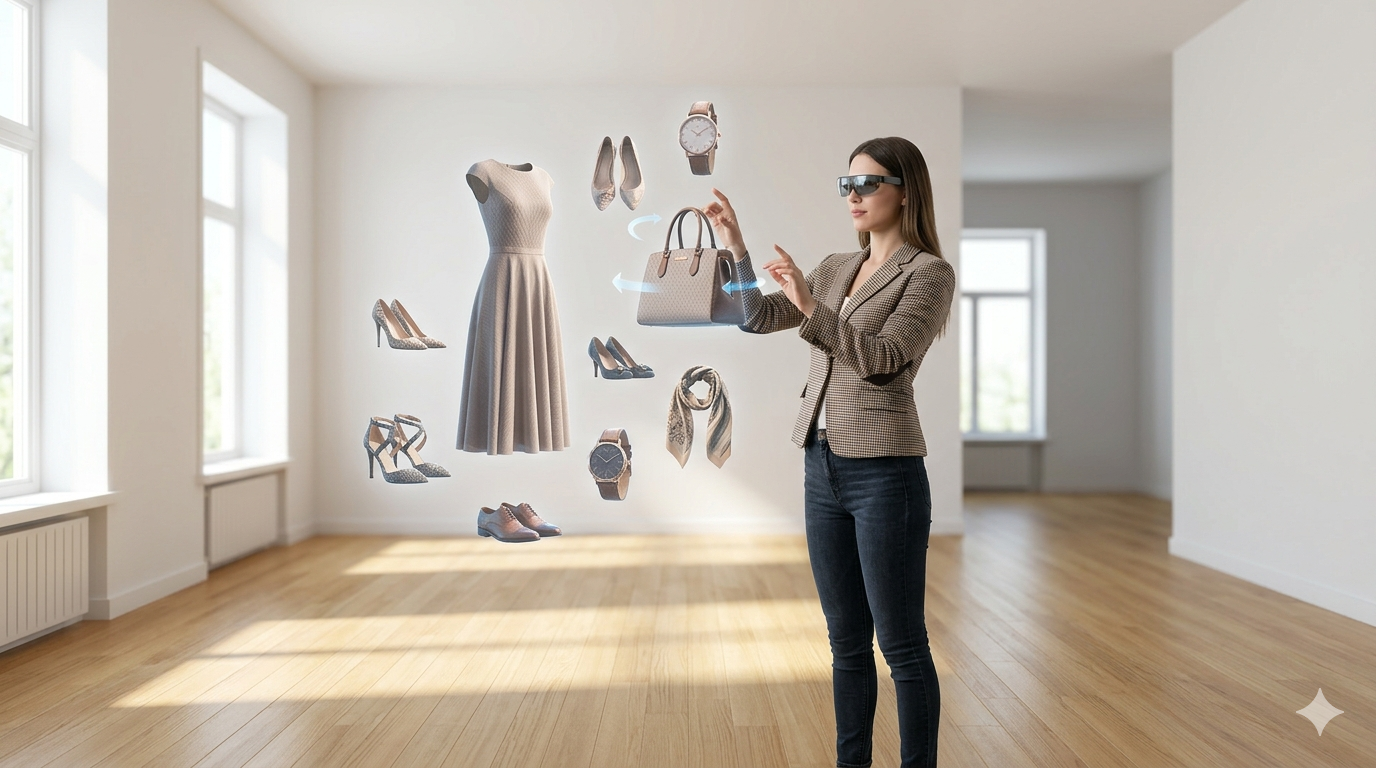
The AR/VR e-commerce experience is a revolutionary technology that closes the gap between physical and digital shopping, allowing customers to experience products before they buy. Augmented reality (AR) and virtual reality (VR) are reducing return rates and dramatically increasing conversion rates, particularly for products such as furniture, clothing, cosmetics and eyewear that are bought with an 'I need to try it first' mindset. According to Gartner's forecasts, millions of consumers will shop from stores offering AR features within the next few years.
Product Try-On with Augmented Reality
AR technology uses the smartphone camera to overlay digital content onto a view of the real world. In an e-commerce context, this technology allows customers to see products in their physical surroundings or on themselves. This removes the biggest disadvantage of online shopping, namely the inability to see and try the product physically. Practical applications exist for many categories, and each requires a different technical approach.
- Furniture and Home Decor: Before buying, the customer can see in real time through their camera how a sofa or coffee table will look in their own room. This application reduces returns due to wrong size or colour by 30-40 per cent.
- Clothing and Fashion: Virtual try-on fitting rooms allow customers to see garments on themselves. Size fit predictions and style suggestions enrich this experience.
- Eyewear and Accessories: In the sunglasses and optical frames category, AR try-on is becoming the industry standard. Warby Parker and Zenni Optical are pioneering examples in this field.
- Cosmetics and Make-Up: Cosmetic applications such as lipstick shade, eyeshadow tone or hair colour changes can be previewed in real time with AR. L'Oreal's ModiFace technology is one of the most successful examples in this area.
Shopify AR: A Ready-Made Solution for E-Commerce
Shopify has integrated AR features into its platform in a way that store owners can use easily. Shopify AR allows 3D models to be uploaded so that customers can examine products from different angles and place them in a real space. Built on ARKit for iOS and ARCore for Android, this feature works directly in the browser without the need to download any additional app. According to Shopify's own research, 3D and AR content increases the conversion rate on product pages by 94 per cent. This striking figure clearly demonstrates that AR is not merely another feature but generates real commercial value.
The IKEA Place App: A Success Story
The IKEA Place app is one of the best-known and most frequently cited success stories of the AR e-commerce experience. The app lets users place products selected from IKEA's furniture catalogue in their home at true scale. Thanks to AR technology, the furniture's colour, texture and shadows are rendered realistically. Following the launch of IKEA Place, return rates were reported to have fallen significantly and customer satisfaction to have risen. This success proves how powerfully AR can influence the purchase decision in a positive direction, particularly for large and expensive products.
WebAR: Augmented Reality Without an App
WebAR technology delivers the AR experience through the web browser without any requirement to download an app. Because this approach reduces user friction to a minimum, it is extremely valuable in terms of conversion rates. Platforms such as 8thWall, ZapWorks and Niantic Studio offer powerful tools for creating WebAR experiences. A WebAR link can be sent to the customer directly from the product page, and the user can instantly experience the product in their real surroundings using their phone's camera. This also creates a powerful content format for campaign marketing and social media sharing in particular.
The Store Experience with Virtual Reality
VR technology makes it possible to recreate the physical store experience entirely in a digital environment. In these experiences, known as virtual stores, customers can walk around the store via a VR headset or a panoramic web view, examine products up close and add them to their basket. This approach is a particularly attractive option for luxury brands, branded experience stores and businesses that want to reach international customers. Tommy Hilfiger, Audi and IKEA are among the brands offering pioneering examples of virtual store experiences.
3D Model Creation and Technology Requirements
High-quality 3D models form the foundation of AR and VR experiences. There are several different ways to create 3D models for your products. Working with professional 3D designers delivers the highest quality results but is the most expensive option. Photogrammetry, which means generating a 3D model through software from multi-angle photographs of the real product, offers a more economical alternative. Tools such as Matterport are used for space scanning, while Capture by Maxon and RealityCapture stand out among photogrammetry solutions. Shopify's 3D Warehouse services also provide store owners with support in this area. GLB or USDZ is usually preferred as the file format for 3D models; GLB is optimised for Android and USDZ for iOS.
Cost and ROI Analysis
When evaluating the return on AR and VR investments, both the costs and the tangible benefits must be taken into account. Initial costs include 3D model creation fees per product, platform licence fees and integration development costs. The cost of creating a professional 3D model for a single product can range from 200 to 2,000 dollars. In return, the average increase in conversion rate observed on e-commerce sites offering an AR experience is reported to be between 40 and 200 per cent. The reduction in return rates also represents a significant cost saving, because the average cost of a product return can reach 15 to 30 per cent of the product's value. Based on these figures, the payback period for an AR investment is generally between 6 and 18 months.
Customer Acceptance and Adoption Rates
The success of AR and VR technologies depends not only on technical quality but on how intuitive and seamless the customer experience is. Research shows that customers who actively use AR features are 3 times more likely to make a purchase than those who do not. However, clear guidance and user-friendly interfaces are essential for these features to be discovered and used. Prominent call-to-action buttons such as 'Try it in your room' or 'View in 3D' increase the visibility of the AR feature. Customer education and including the feature in campaign communications are also important for raising adoption rates.
Frequently Asked Questions
What technical infrastructure is required for an AR feature?
No special infrastructure is required for WebAR; integrating a 3D model into your product page is sufficient. If you use Shopify, the platform supports this natively. For custom development, libraries such as 8thWall or Model Viewer can be used. The critical requirement is high-quality 3D models in GLB and USDZ formats.
Can small e-commerce stores afford AR?
Yes, pricing has now become largely democratised. Creating 3D models for just a handful of best-selling products and using Shopify's built-in AR feature is possible on a reasonable starting budget. Creating your own 3D models with photogrammetry apps can reduce the cost even further. Starting with products that have high return rates or that are difficult to decide on offers the best ROI.
Does AR really reduce return rates?
Yes, research consistently confirms this effect. Furniture retailers such as Wayfair and IKEA report that return rates among AR users fall by 20-40 per cent. In the clothing category, virtual fitting rooms also reduce return rates significantly. The underlying reason is simple: when the customer can see the product's true size, colour and fit with its surroundings in advance, the likelihood of surprises is lower.
How much does it cost to create a VR store experience?
While simple 360-degree virtual tour experiences can be created at relatively low cost, fully immersive VR store experiences require a significant development investment. Space scanning and 360-degree tour creation with Matterport can be done for a few thousand dollars, whereas VR applications that include an interactive shopping experience can require tens of thousands of dollars. The virtual tour format offers a more cost-effective entry point to begin with.
Conclusion
The AR/VR e-commerce experience is among the leading technologies shaping the future of digital shopping. Shopify AR, WebAR solutions and virtual store experiences are no longer the privilege of early adopters and are becoming the competitive standard. Investing in these technologies, which deliver tangible value in terms of higher conversion rates, fewer returns and greater customer satisfaction, should be a strategic priority for e-commerce businesses. Contact Toserof Tech. for AI and e-commerce solutions.