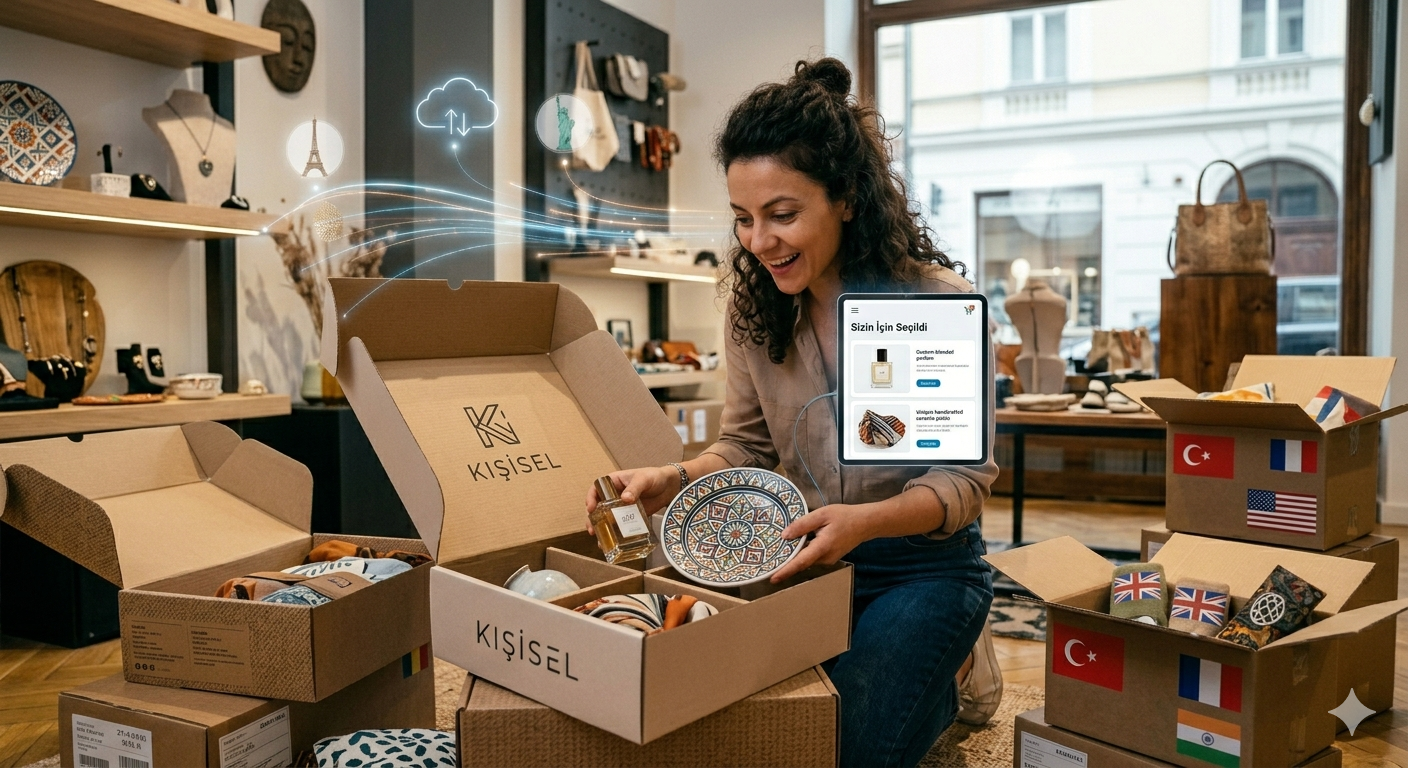
The AI-personalised shopping experience has become one of the most powerful growth engines in today's e-commerce. Instead of a one-size-fits-all shopping experience, customers now expect recommendations, content and offers shaped around their own tastes and behaviour. Artificial intelligence turns this expectation into reality, significantly increasing both customer satisfaction and business revenue.
Why Is Personalisation Critical in E-Commerce?
According to McKinsey research, personalisation helps companies increase their revenue by 10 to 15 per cent. A study by Epsilon found that 80 per cent of consumers are more likely to buy from brands that offer personalised experiences. These figures clearly show that personalisation is no longer a luxury but a competitive necessity. While traditional marketing approaches deliver the same message to everyone, AI-powered personalisation addresses each customer individually and can anticipate their needs in advance.
- Higher Conversion Rate: Personalised product recommendations generate 3-5 times higher click-through and purchase rates than generic recommendations.
- Customer Lifetime Value: Customers who enjoy an experience tailored to them shop more often and have higher basket values.
- Lower Customer Churn: Personalised communication and recommendations strengthen customer loyalty and reduce the churn rate.
- Competitive Advantage: For mid-sized businesses that want to compete with major brands, personalisation is the most effective tool for differentiation.
- Stock Optimisation: Systems that anticipate customer preferences provide valuable data on which products should be promoted.
Collaborative Filtering: The Power of Similar Users
Collaborative filtering is one of the cornerstones of personalised recommendation systems. This approach is built on recommending the preferences of users with similar behaviour patterns to one another. Amazon's famous 'Customers who bought this item also bought' section is the best-known example of collaborative filtering, and these recommendations account for roughly 35 per cent of Amazon's revenue.
User-Based Collaborative Filtering
User-based collaborative filtering finds other users with a shopping history similar to that of the target user and recommends the products they liked that the target user has not yet seen. For example, if user A and user B have viewed the same 10 products and user B has bought 3 of them, those 3 products can also be recommended to user A. This method is extremely effective, particularly on platforms with a large user base, but a 'cold start' problem can arise for new users.
Item-Based Collaborative Filtering
Item-based collaborative filtering, on the other hand, analyses the relationships between products that are bought together or viewed together. This method is computationally more efficient than the user-based approach because product relationships remain more stable over time. When a customer buys a leather jacket, the system automatically recommends leather care products or belt styles that are frequently bought together with such jackets.
Content-Based Filtering: Recommendations Based on Product Attributes
Content-based filtering analyses the attributes of products the user has previously shown interest in and recommends new products with similar attributes. In this approach, machine learning algorithms process product descriptions, categories, price ranges, brand information and other metadata to build a user profile. If a user shows interest in trousers that are blue, slim fit and in a particular price range, the system will prioritise new products with these attributes in its recommendations. The greatest advantage of content-based filtering is that it works easily for new products too and suffers less from the cold start problem that affects collaborative filtering.
Real-Time Personalisation
Real-time personalisation refers to analysing a customer's behaviour as they browse your site and applying personalisation live. Unlike traditional batch processing methods, this approach can make decisions within milliseconds. Data such as which products the customer viewed and for how long, which filters they used and which price range they browsed is processed instantly and the page content is rearranged accordingly.
Homepage Personalisation
The homepage is the most valuable digital real estate of any e-commerce site. AI-powered systems can arrange the homepage differently for every visitor. A new visitor can be shown popular products and featured categories, while a regular customer can be presented with the categories they viewed most recently, alternatives similar to products they added to their basket and personal promotions. This approach is reported to increase conversion rates by 20 to 40 per cent.
Email Personalisation
Email marketing offers one of the most powerful applications of personalisation. Instead of sending a generic newsletter, it is possible to create email flows that are triggered by each subscriber's behaviour and deliver content tailored to the individual. In abandoned basket emails, showing the products the customer left behind along with similar alternatives significantly increases the return rate. Birthday campaigns, purchase anniversaries and browse abandonment emails are other areas where personalisation is effective.
Segment of One: Individual Personalisation
The concept of the 'segment of one' goes beyond traditional segment-based marketing and treats every customer as a segment in their own right. Whereas classic marketing divides customers into broad categories such as age, gender or geography, the segment-of-one approach delivers fully customised experiences based on each individual's unique behaviour patterns, purchase history and preferences. Although this approach requires big data processing capacity and advanced machine learning models, when implemented correctly it dramatically increases customer loyalty and lifetime value.
Leading Personalisation Tools
Many powerful tools are available on the market for e-commerce personalisation. These tools offer rapid integration without the need for technical expertise, making it possible for small and medium-sized businesses to deliver enterprise-grade personalisation too.
- Nosto: Offering easy integration with Shopify, WooCommerce and Magento, Nosto provides a complete personalisation solution with AI-powered product recommendations, personalised emails and pop-up optimisation. It is particularly well suited to mid-sized e-commerce businesses.
- Barilliance: Specialising in real-time behavioural personalisation, Barilliance offers more than 30 recommendation widgets, abandoned basket recovery tools and personalised email solutions. It is a strong option for businesses with large catalogues.
- Dynamic Yield: Trusted by major brands such as McDonald's, Dynamic Yield offers enterprise-level solutions for omnichannel personalisation, A/B testing and predictive targeting. It enables consistent personalisation across all channels, including web, mobile app, email and kiosk.
- Recombee: An API-based recommendation engine, Recombee offers flexible integration options for developers and stands out for its real-time learning capabilities.
Success Metrics: Measuring the Impact of Personalisation
Measuring the impact of your personalisation efforts accurately is critical for optimising your strategy and proving return on investment. Key metrics include recommendation click-through rate (CTR), recommendation conversion rate, growth in basket size, growth in revenue per customer and change in customer lifetime value (CLV). Through A/B tests it is possible to measure how much additional revenue personalisation initiatives generate compared with a control group. Attribution modelling is needed to understand which personalisation touchpoint contributes most to conversion.
Balancing Personalisation with GDPR
Under the European Union's GDPR regulation and Turkey's KVKK, certain rules must be followed when collecting personalisation data. Obtaining explicit consent from users, transparently explaining which data is collected and giving users the right to delete their data are among the primary legal obligations. In line with the data minimisation principle, only data that is genuinely necessary for personalisation should be collected. When setting up cookie consent mechanisms, personalisation cookies should be flagged separately and user preferences respected. Personalisation carried out without an appropriate privacy infrastructure can have dangerous consequences in terms of both legal risk and loss of customer trust.
Frequently Asked Questions
How much data is needed for personalisation?
You do not need thousands of customers and millions of transactions to start effective personalisation. A few thousand active users are sufficient for collaborative filtering, while content-based filtering can start working with nothing more than product catalogue data and user session data. What matters is data quality and accuracy. The healthiest approach is to start small and refine the algorithms as data volume grows.
How long does it take to integrate personalisation tools?
A basic integration of tools such as Nosto or Barilliance with a Shopify or WooCommerce store can be completed within a few hours. However, the algorithms are in a learning phase during the first weeks and personalisation quality improves over time. A learning period of 4 to 8 weeks is usually needed to achieve fully productive results.
Can small e-commerce stores benefit from personalisation?
Yes, even small stores can benefit significantly from simple personalisation tactics. Personal product reminders in abandoned basket emails, 'If you liked this, you may also like' sections and personalised banners for returning visitors are effective starting points that can be implemented on a low budget. Many tools offer affordable entry-level plans for small stores.
Does personalisation violate customer privacy?
When the principles of transparency and explicit consent are followed, personalisation does not constitute a privacy violation. It is sufficient to clearly state to customers which data is collected, obtain their consent and give them the option to opt out whenever they wish. Research shows that the vast majority of customers prefer personalised experiences as long as they know their privacy is protected.
Conclusion
The AI-personalised shopping experience is one of the most effective ways to stay competitive in e-commerce and strengthen customer loyalty. Technologies such as collaborative filtering, content-based filtering and real-time personalisation are no longer the preserve of major platforms but tools available to businesses of every size. With the right platform choice, compliance with data privacy rules and continuous optimisation, your personalisation efforts can translate into tangible business results. Contact Toserof Tech. for AI and e-commerce solutions.